
Baccarat Pro Review 2026
Overview
NetEnt's Baccarat Pro is a Punto Banco card table game with a Banker bet RTP of 98.76% and no player decisions after the initial wager.
Baccarat Pro is one of the simplest and most player-favorable table games available online. Bet Banker every time, avoid Tie, and treat side bets as occasional entertainment rather than a strategy. The math is clean, the pace is fast, and the 98.76% Banker RTP is hard to argue with.
How It Plays
RTP, Volatility & Fairness
Full Review
NetEnt’s Baccarat Pro is a Punto Banco card table game, and it carries a Banker bet RTP of 98.76%, which puts it among the best-value bets in any casino lobby. I find it appealing precisely because of its simplicity: after you place your bet, the game plays itself. Every card draw follows fixed rules. No strategy chart, no decisions in the hand, no second-guessing. Just one bet, placed before the cards are dealt.
The three betting options are Banker, Player, and Tie. Banker at 98.76% RTP and Player at 97.85% RTP are both solid. Tie at 85.56% RTP is not. That 85.56% figure means the casino expects to keep 14.44% of every euro placed on Tie. For comparison, European Roulette’s house edge is 2.70%. Tie is, mathematically, one of the worst bets in the table game section of any online casino. I place it here plainly so there’s no ambiguity later in the review.
Baccarat in its Punto Banco form is the version found at every major online casino. It traces its roots to Italy and France, arrived in Macau and Las Vegas, and has since become the highest-grossing table game in casino history by total wagered volume. The digital version brings the same math and pace to your browser or mobile screen, with minimum bets starting at €1.
How Baccarat Plays
The objective in baccarat is to bet on which of two hands, Banker or Player, will end closest to a point total of 9. Both hands are dealt by the game, not controlled by the person sitting at the table. You’re not playing a hand yourself. You’re betting on an outcome.
The point system works like this: cards 2 through 9 are worth their face value. Aces are worth 1. Tens, jacks, queens, and kings are worth 0. When a hand total exceeds 9, the tens digit is dropped. So a 7 and a 6 (total 13) becomes a hand worth 3. A hand worth 8 or 9 from the first two cards is called a “natural” and wins immediately without further draws.
The drawing rules are fixed and require no decision from you. For the Player hand: if the total after two cards is 0 through 5, Player draws a third card. If the total is 6 or 7, Player stands. A natural 8 or 9 ends the round. For the Banker hand, the drawing rule is more complex and depends on both the Banker’s two-card total and whether Player drew a third card. In broad terms, Banker draws on 0 through 2 almost always, and on 3 through 6 conditionally based on what card Player drew. Banker always stands on 7. On natural 8 or 9, Banker stands regardless. The full drawing table is available in the game’s help section. You don’t need to memorize it since the game applies it automatically.
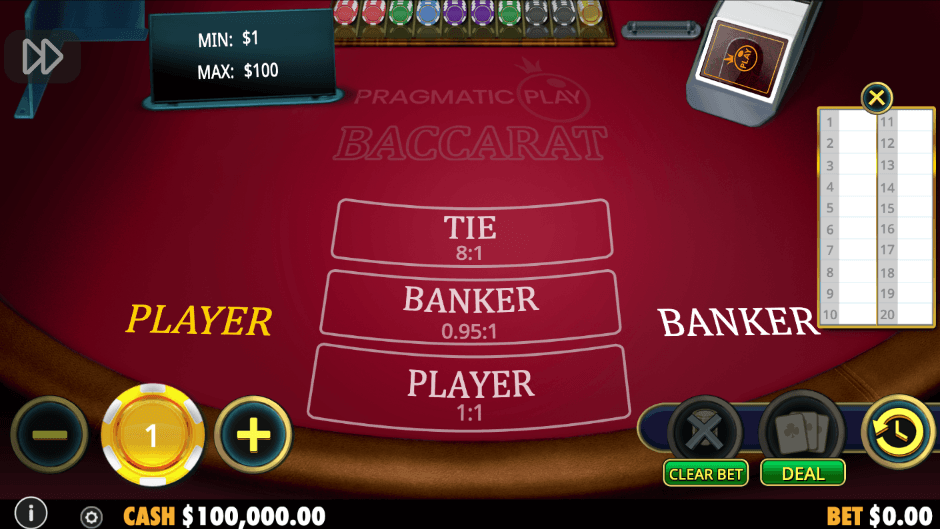
Once all cards are dealt and all draws resolved, the hand closest to 9 wins. If Banker wins and you bet Banker, you’re paid 0.95:1 (the 5% commission is deducted). If Player wins and you bet Player, you’re paid 1:1. A Tie bet wins at 8:1 if the final totals are equal. If you bet Banker or Player and the result is a Tie, the round is a push and your bet is returned.
Bets, Payouts & Side Bets
The three main bets have meaningfully different RTPs that are worth setting out clearly. Banker at 98.76% is the highest RTP bet on the table. The 5% commission on Banker wins sounds like a disadvantage, but the Banker position wins slightly more than half of all non-Tie hands due to the way the drawing rules are structured. Even after the commission, Banker’s expected value is better than Player’s. Player at 97.85% is the second choice. It pays 1:1 with no commission deducted, which is cleaner, but the math still favors Banker. Tie at 85.56% is a 14.44% house edge. The 8:1 payout sounds attractive compared to the near-even payouts on Banker and Player, but it’s priced correctly as a long-shot bet with a high house take. Most experienced baccarat players avoid Tie entirely.
Side bets are available in Baccarat Pro and add optional wagers on specific outcomes. Player Pair pays 11:1 if the Player’s first two cards form a pair. Banker Pair pays 11:1 for the same on the Banker side. Perfect Pair pays at higher odds for a pair of matching suit and value. Either Pair covers both sides. The house edge on pair bets varies but typically runs between 10% and 15%, making them significantly worse than the Banker main bet in expected value. They’re priced as high-variance side bets for players who want occasional big wins within the baccarat session, not as primary strategy.
The 8-deck shoe used in Baccarat Pro matters for one practical reason: it keeps the game running without a re-deal for many hands, which is why you’ll often see a “shoe remaining” indicator in the interface. The RNG in digital baccarat shuffles after each hand, so the shoe tracker is largely cosmetic in the online context. In live baccarat, the shoe is physically dealt, and the card compositions within it are real.
Strategy & House Edge
Baccarat strategy is straightforward: bet Banker. That’s the complete optimal strategy for Punto Banco. The Banker position wins approximately 45.86% of rounds, Player wins approximately 44.62%, and approximately 9.52% of rounds end in a Tie (after which both main bets push). Banker’s slight structural advantage comes from the drawing rules, which favor the Banker hand finishing stronger in a range of scenarios. The 5% commission offsets but does not eliminate that advantage.
Many baccarat players keep score of recent results using a scorecard, tracking whether Banker or Player won the last several hands. This is a completely reasonable way to track the session, but it has no predictive value. Each hand is independent. Baccarat has no memory, and no streak analysis changes the underlying probability of the next hand’s outcome. I’ve found that players who understand this enjoy the game more, since they’re no longer frustrated when a “Banker streak” ends.
Side bets should generally be limited or skipped entirely if your goal is maximizing expected value per session. Adding Player Pair or Banker Pair bets alongside every main bet can shift your overall session RTP significantly downward from the 98.76% Banker baseline. Playing them occasionally for the entertainment value of a high payout is reasonable. Relying on them as a regular part of your betting is not.
Where to Play Baccarat Pro
NetEnt’s Baccarat Pro is available at most major online casinos carrying NetEnt’s table game suite, which covers most major licensed operators. Playtech, Microgaming, and Evolution also publish their own baccarat variants under the same Punto Banco rules and comparable RTPs. Demo play is available for RNG versions at most casinos without requiring a deposit, which is a good way to get comfortable with the pace of the game and the interface.
Live baccarat is where the game has its widest following. Evolution Gaming operates multiple live baccarat tables including Speed Baccarat, No Commission Baccarat, and Lightning Baccarat, all streamed from dedicated studios. In No Commission Baccarat, the 5% commission is removed but Banker wins paying 6 (Banker total of 6 winning) pay at a reduced rate, keeping the overall math similar. Live baccarat typically has higher table minimums than the RNG version. Both formats play identically on mobile.