

Deal or No Deal Live Review 2026
Overview
Evolution Gaming's live casino adaptation of the TV game show: a qualification round where every player wins a briefcase multiplier (1x to 100x), a Banker negotiation phase, and 95.42% RTP. The highest multiplier briefcases can reach 50,000x.
Deal or No Deal Live by Evolution is the most faithful live casino adaptation of a TV game show format. The qualification phase is clever: every player gets a guaranteed briefcase with a real multiplier before the main game begins, which makes the 'deal or no deal' decision genuinely personal. The 95.42% RTP is the lowest of Evolution's main game show lineup, and the Banker's offers are calibrated to make accepting them feel attractive even when the expected value slightly favors playing on. That tension is exactly what the TV format was built on, and it translates well.
How It Plays
Game Features
RTP, Volatility & Fairness
Full Review
Deal or No Deal Live is Evolution Gaming’s adaptation of the international television game show, licensed from Banijay, first released in 2018. The RTP is 95.42%, the lowest certified figure in Evolution’s main live game show lineup, and the format is built around a mechanic that no other game in Evolution’s catalog uses: every player who qualifies enters the main event holding their own personal briefcase with their own multiplier inside. This isn’t a shared wheel where everyone wins or loses together. Your briefcase is yours. That distinction matters more than it might initially seem, because it’s what turns the Banker’s offer into something that feels genuinely personal rather than an abstract math problem.
The TV format it’s based on became a global phenomenon precisely because it places the viewer in a direct decision: accept what’s offered now, or gamble on what might be in your case. Evolution’s version carries that tension directly into a live casino setting, and they’ve managed it well. The Banker in Deal or No Deal Live behaves like the TV show’s Banker, offers that are designed to be tempting without being mathematically generous. That design choice is intentional and it’s central to why the format works as an entertainment product.
I’ll note the 95.42% RTP honestly and directly: it’s lower than Dream Catcher’s 40-segment return (96.58%) and lower than Monopoly Live’s overall figure (96.23%). For players who are RTP-sensitive, this is a meaningful difference in expected session return. What Deal or No Deal offers in exchange for that lower figure is a format that’s genuinely unlike the other Evolution game shows, the qualification mechanic and the personal briefcase create an experience that some players find more compelling than a shared wheel spin.
How Deal or No Deal Live Plays
The game runs in two distinct phases: a qualification round and a main game. They play out in sequence for every round, and the qualification phase is what makes this game structurally unique in Evolution’s lineup.
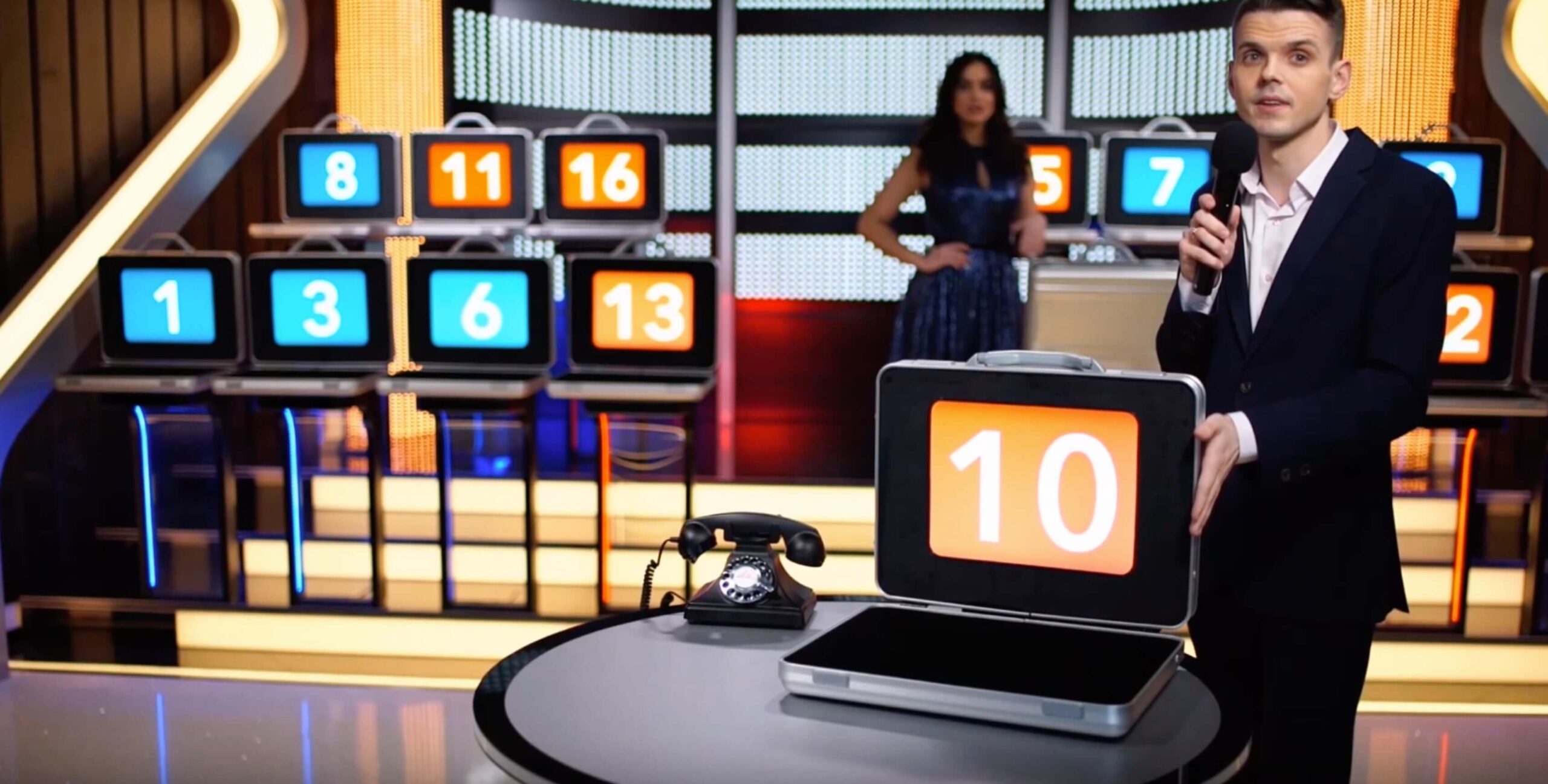
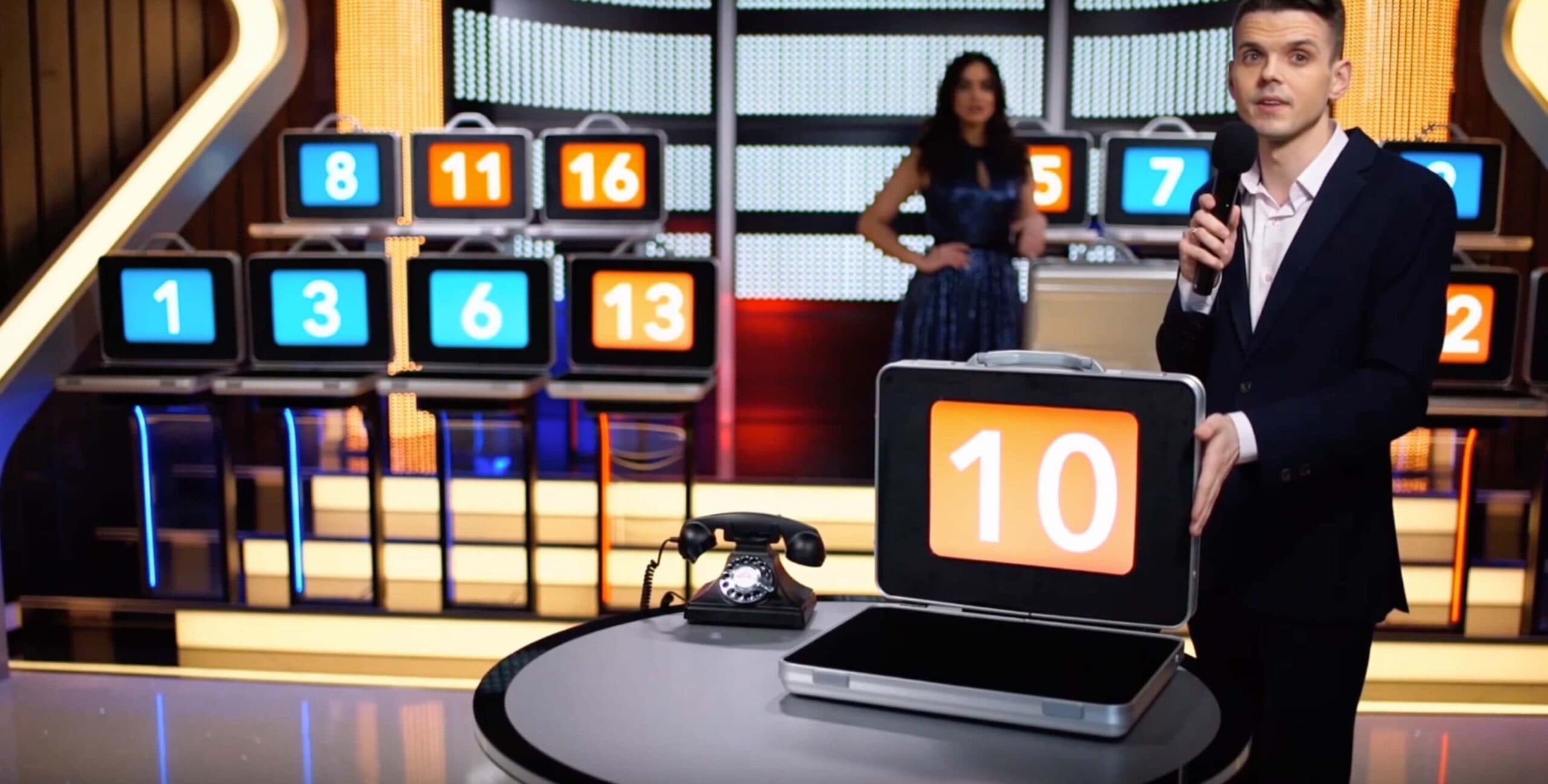
In the qualification round, 16 briefcases appear on screen. Each briefcase hides either a ball color indicator or a multiplier value. Players click briefcases one at a time to reveal what’s inside. A yellow ball means that case is kept in the game. A red ball means it’s eliminated. Players need to reveal enough yellow balls to qualify for the main game. The timing is player-controlled within the round’s window, click at your own pace, and keep going until you’ve collected the required number of yellow balls. Every player who qualifies then picks one of the remaining valid briefcases as their personal case for the main game. That chosen briefcase holds a multiplier value ranging from 1x to 100x of their stake. You don’t know which value you’ve picked at this point, that’s the whole structure.
The minimum bet is €0.10 and the maximum is €5,000. The multiplier in your briefcase, combined with your bet size, determines the maximum you can win if you hold to the end without dealing. A €5,000 bet with the 100x briefcase pays €500,000 if held to the end.
The main game runs on the live set. A presenter opens the remaining briefcases in groups, revealing their multiplier values and eliminating them from the field. After each group of reveals, the Banker calls with an offer, a multiplier value to buy out your briefcase. The Banker’s offer is displayed on screen; you choose DEAL (accept the offer, collect that multiplier on your bet, the round ends for you) or NO DEAL (reject the offer, continue to the next reveal group). The round continues until either a player deals or all briefcases are opened and the player takes whatever their original briefcase held.
Special Features & Bonus Rounds
Deal or No Deal Live has no traditional bonus round in the sense of a secondary phase triggered by a specific event. The game’s entire structure is the feature: the qualification phase, the personal briefcase pick, and the Banker negotiation sequence across multiple reveal groups. Understanding the Banker’s offer mechanics is where the game’s real depth is.
The briefcases in the main game contain multiplier values ranging from 1x to 100x. The distribution is not even, there are multiple low-value briefcases (1x, 2x, 3x and similar) and progressively fewer as the values increase, with a single 100x briefcase in the field. This distribution mirrors the TV format’s tension: most cases hold modest values, the high-end cases are rare, and not knowing which one you picked is the source of the game’s uncertainty.
The Banker’s offer structure is the format’s defining mechanic. In the TV show, the Banker’s offers were calibrated to be below the pure expected value of the remaining briefcases, compelling enough to accept, but not so generous that taking them was obviously the right call. Deal or No Deal Live follows the same design principle. A player who calculates the pure expected value of the remaining briefcases and the probability that their own case is in the high-value group will often find the Banker’s offer is slightly below that figure. Not dramatically below, usually close enough that accepting it feels reasonable, but structurally below.
This creates a behavioral economics effect that the TV format made famous. The certainty of accepting the Banker’s offer is psychologically attractive even when the math favors playing on. Players tend to overvalue the sure thing relative to the expected value of continuing, especially after multiple rounds of watching high-value briefcases be eliminated. That tension (the gut pull to take the certain offer versus the rational argument to continue) is what the game is built on. It works the same way in a live casino setting as it did on television.
Each reveal group eliminates cases from the field and narrows the remaining distribution. Early in the main game, the range of possible outcomes is wide and the Banker’s offer will be modest. After several rounds of reveals, particularly if high-value cases have been eliminated and your own case is more likely to be high-value, the Banker’s offers increase. The decision becomes progressively more constrained, and more consequential, with each passing round.
There is no Top Slot mechanic, no compounding multiplier chain, and no secondary game format. The drama is entirely within the single-game negotiation structure, which is more contained than Monopoly Live or Crazy Time but more individually personalized than any shared-wheel format.
RTP, Volatility & Max Win
The certified RTP for Deal or No Deal Live is 95.42%. That figure is the weighted average return across all possible outcomes: qualification results, briefcase distributions, Banker offer acceptance rates, and the full range of end-game scenarios where a player holds to the end and gets their case’s value. It’s the lowest certified RTP among Evolution’s main game show titles. Dream Catcher’s 40 segment returns 96.58%; Monopoly Live returns 96.23% overall. The 95.42% on Deal or No Deal represents a roughly one percentage point disadvantage per session compared to the better-positioned alternatives in Evolution’s lineup.
Volatility is high. The briefcase value distribution is weighted toward lower multipliers (many cases hold 1x to 10x values) with the highest values (50x, 75x, 100x) being rare in the field. Most qualification rounds result in a briefcase holding a modest multiplier, and most main games where a player holds to the end produce a low-to-mid-range result. The sessions that produce large wins involve holding to the end with a high-value briefcase, which requires both picking the right case during qualification and not dealing too early when the Banker’s offer is compelling but still below the 100x ceiling.
The maximum achievable win is 100x the player’s bet, which is the value of the single 100x briefcase held to the end without accepting any Banker offer. At the maximum €5,000 bet, that produces a €500,000 gross win. This is a hard ceiling, there’s no compounding mechanism to go beyond 100x, unlike Dream Catcher’s open-ended multiplier stacking. The 100x ceiling is lower than Monopoly Live’s board round potential under Top Slot conditions, but the format delivers that ceiling within a single, continuous game session rather than requiring a specific bonus event to trigger first.
On responsible gambling: Deal or No Deal’s Banker mechanic is specifically engineered to create decision pressure. The format uses the certainty effect and loss aversion, well-documented behavioral patterns, to make accepting below-EV offers feel reasonable. Players should be aware that the game’s tension is a product of that design, not a reflection of actual strategic complexity. Setting a personal decision rule before entering a session (for example, “I deal only if the offer exceeds X% of the 100x maximum”) removes some of that in-session pressure. Gambling is not a reliable income source, and holding for the 100x briefcase is a low-probability outcome regardless of how the game session feels moment to moment.
Where to Play Deal or No Deal Live
Deal or No Deal Live is part of Evolution Gaming’s live game show catalog and runs at any regulated casino carrying the Evolution live suite. It was among the first licensed television format games Evolution brought to live casino, released in 2018, a year before Monopoly Live, and it remains in active rotation at licensed operators across Europe, Canada, and other markets where Evolution holds certification. As with all Evolution live game shows, there’s no demo mode: play requires a real-money bet and a live session connection to the studio.
Mobile play works well. The qualification round’s briefcase-clicking interface is designed for touch screens, and the main game’s deal/no deal decision interface is simple enough to operate cleanly on portrait mobile. The live streaming from Evolution’s studio is the same feed as desktop, the same presenter, the same briefcases, the same Banker calls. Resolution scales to the device connection. The format is one of the more mobile-friendly in Evolution’s live catalog because the player interaction is minimal (tap briefcases, tap DEAL or NO DEAL) and the game itself provides the complexity through its structure rather than through interface density.