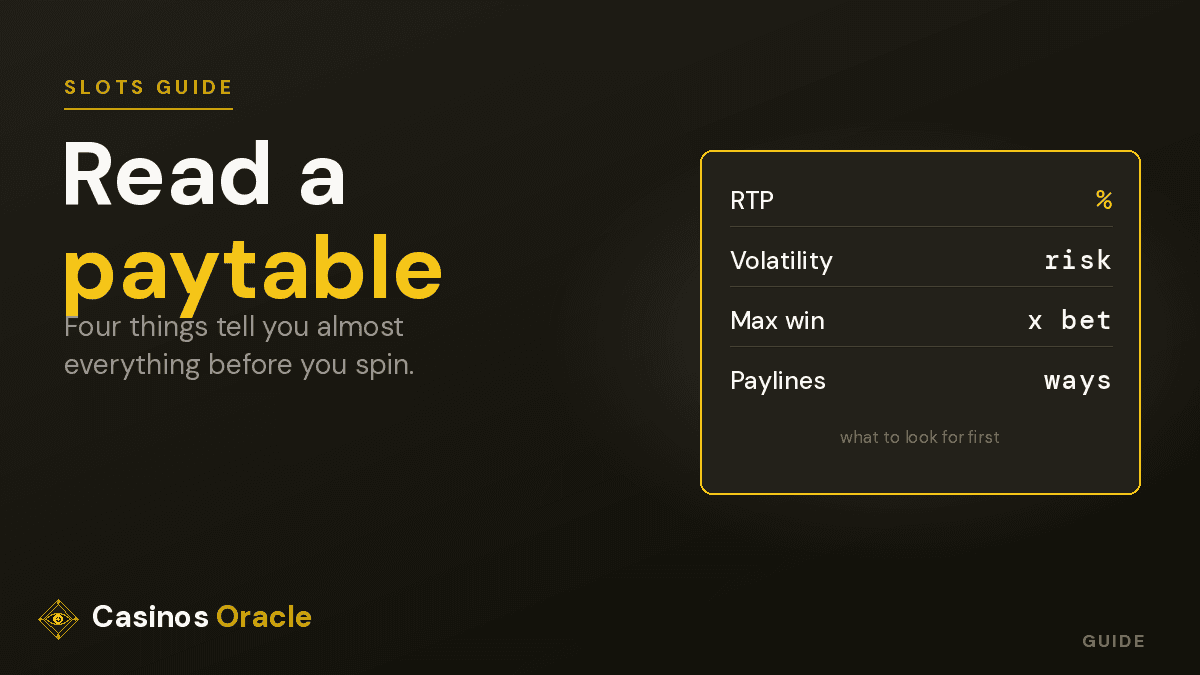
Every online slot has a paytable, a screen (or set of screens) that documents exactly how the game works. Symbol values, payline rules, wild behavior, scatter triggers, bonus mechanics, RTP, and max win cap: it’s all in there. Hit the “i” or “?” button on any game to open it. Most players spin without reading it. Spending two minutes here before your first real-money spin will change how you think about slot selection.
Where to Find the Paytable
Look for an information icon (“i”), a question mark (“?”), or a menu button on the game’s interface, usually in a corner. Tapping or clicking opens the paytable. Most modern slots break it across several screens navigable by arrow buttons. Read the whole thing, not just the first screen.
Symbol Values: What You’re Actually Paid
The first section of most paytables shows symbol values, what each symbol pays for landing 3, 4, or 5 on a payline (or 2 on some games with premium symbols). These values are expressed as multiples of your bet or line bet.
Key things to note:
- The gap between high and low symbols matters. If the highest symbol pays 500x and the lowest pays 0.1x, the low-pay symbols contribute almost nothing, hitting five of them pays less than your bet. This is extremely common in high-volatility slots, where winning is concentrated in premium symbols and bonus features.
- Pay per line vs pay per bet. Some paytables express values as multiples of your total bet; others use your line bet (total bet ÷ number of paylines). Make sure you know which applies before estimating expected payouts.
- The premium-to-low ratio reveals volatility. A wide gap between top and bottom symbol values usually signals high volatility. Tight spacing across all symbols suggests lower volatility with more frequent small wins.
Payline Rules: How Wins Are Counted
The paytable explains how winning combinations are counted:
- Fixed paylines: wins count only on specific predefined line patterns. The number of active lines is fixed (or you can choose how many to activate on older games, activating fewer than all is almost never advisable as it reduces coverage).
- All-ways-pay: any combination of matching symbols on consecutive reels from left to right counts as a win, regardless of exact position. Typically described as “243 ways,” “1,024 ways,” or similar.
- Megaways: the payway count changes each spin (the paytable will explain the variable reel mechanic and the maximum ways count).
- Cluster pays: matching symbols must form clusters of connected symbols rather than left-to-right paylines. Games like Aloha! Cluster Pays (NetEnt) use this system.
Wild and Scatter Rules
The paytable defines exactly what wilds and scatters do in that specific game, including any variants. Never assume from previous games. A “wild” in one slot might be a simple substitute; in another it might expand, stick, multiply, or trigger re-spins. The paytable section covering wilds typically includes:
- Which symbols the wild substitutes for (almost always: all regular symbols, never scatter/bonus)
- Any additional behavior: expanding, sticky, multiplier, walking
- Whether wilds appear on all reels or restricted reels (many games exclude reel 1)
The scatter section tells you how many you need to trigger the bonus (usually 3 minimum), whether scatters pay on their own for landing fewer than 3, and whether they appear on specific reels only.
Bonus Feature Rules
This is the most important section for high-volatility slots. The paytable explains how the free spins bonus works, how many spins you receive, what multiplier mechanics apply, whether retriggers are possible, and what enhancements activate during the feature (stickier wilds, removed low-pay symbols, etc.).
Some paytables also include the feature buy price here, the cost to purchase instant bonus access, expressed as a multiple of your total bet. On most games this is 80–100x, but it varies. And some paytables note that the feature buy carries a slightly different (often higher) RTP than the base game trigger, worth checking if you use this option regularly.
The RTP and Max Win Cap
Two numbers often buried at the end of the paytable that deserve specific attention:
RTP: The theoretical return to player for this game at this casino. If the same slot runs at different RTPs on different sites (which is increasingly common with multi-RTP games), the paytable at your specific casino shows which version you’re playing. This is the number to check, not the provider’s promotional materials.
Max win cap: Most modern slots have a maximum win per spin, typically between 5,000x and 25,000x your bet. If a game’s max cap is 5,000x but a cascade chain would theoretically produce 8,000x, the game clips the payout at 5,000x. This is significant for high-volatility games: Pragmatic Play caps many of their slots at 5,000x, which is a different proposition than an uncapped game like Bonanza where the math allows much higher theoretical wins (250,000x in extreme cases).
A Two-Minute Paytable Checklist
Before spinning a new slot for real money, spend two minutes checking:
- RTP, is it at or above 96%?
- Max win cap, what’s the ceiling?
- Premium symbol values, does the top symbol pay at least 100x?
- Bonus trigger, how many scatters needed, which reels?
- Multiplier mechanics, does the bonus use a progressive multiplier?
- Max bet rules, what’s the maximum bet allowed (especially relevant if using a bonus)?
This checklist takes under two minutes and gives you a clear picture of what you’re playing before any money changes hands.
Best Casinos for Slots with Transparent Paytables
- ★ Editor's #1 Pick — Best Casino Bonus










Sir Casinos may receive compensation when you click links. Gambling involves risk. 18+ only. Play responsibly.